
Professionals involved in development, such as those at housebuilders and local authorities, need to stay informed about the latest developments in environmental compliance. To help with this, Thomson Environmental Consultants has produced the 2026 environmental compliance checklist.
This year will see a range of environmental legislative changes, policy shifts, phased rollouts, and compliance updates in the UK.
Our new environmental compliance checklist is an easy-to-digest, downloadable guide that serves as a quick reference to ensure you know what needs to be done, when, and how to comply.
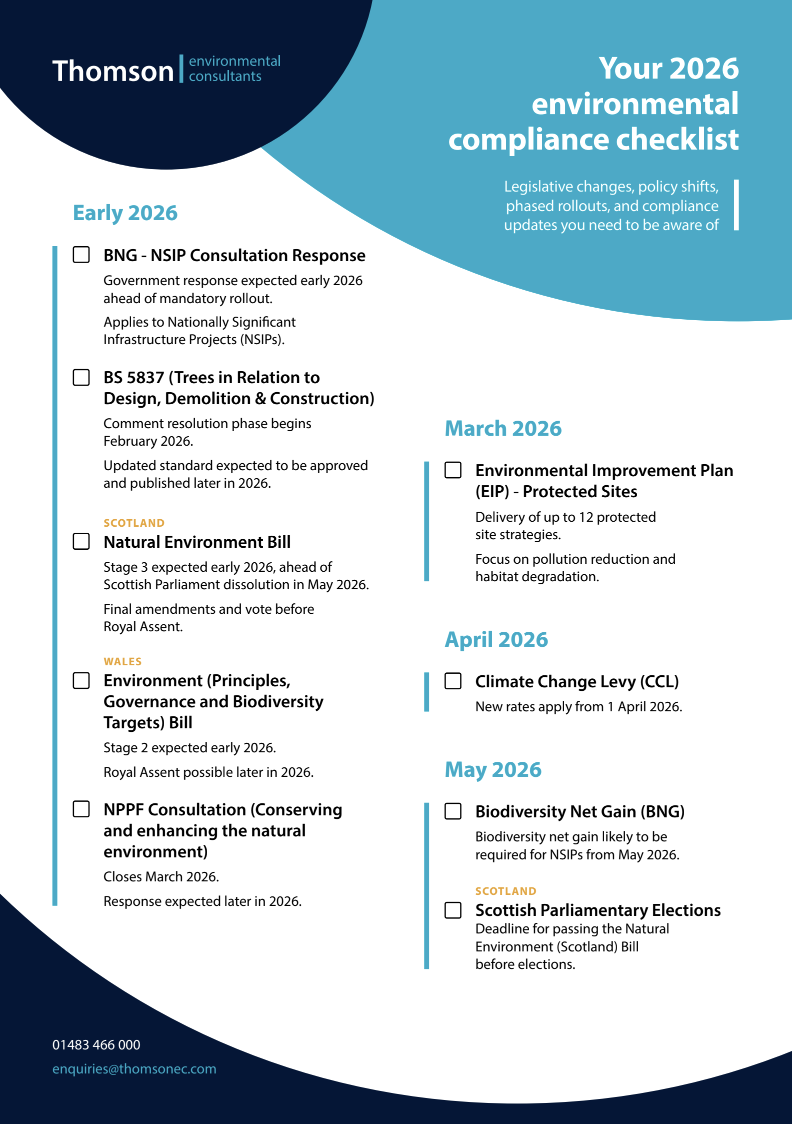
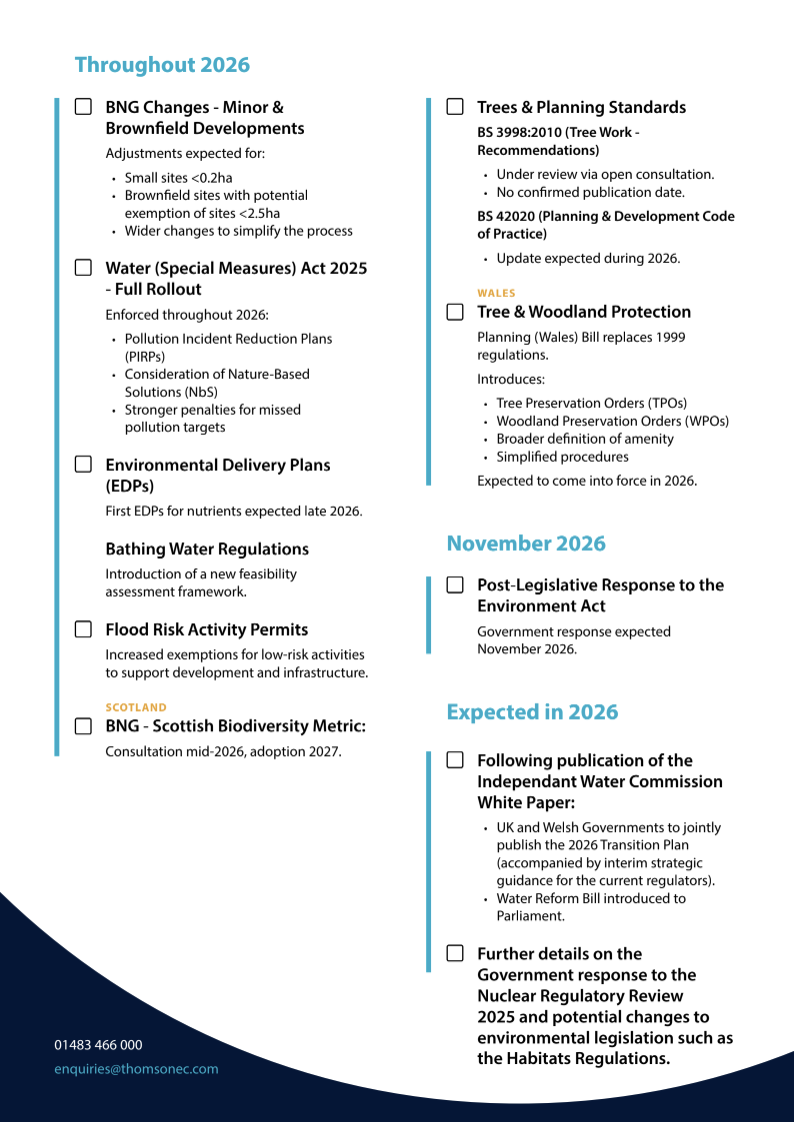
Download Thomson Environmental Consultants’ compliance checklist 2026
What is environmental compliance in the UK?
Environmental compliance means adhering to laws, regulations, and standards regarding the environment. Being environmentally compliant ensures your business and the activities it undertakes avoid or mitigate potential impacts on the surrounding land, air and water. Government bodies such as The Environment Agency and Natural England enforce these rules.
Why is it important to be aware of these dates and events?
Legislation is often introduced through phased rollouts, policy transitions, and staggered enforcement dates. With this in mind, it’s important to understand when these changes might take effect, as it allows you to plan ahead, consider project timelines, and avoid last-minute slip ups that can be costly and disruptive.
Remaining informed also helps prevent the consequences of non-compliance, which can include enforcement action, financial penalties and development delays.
Awareness of these dates reduces uncertainty and allows organisations to demonstrate due diligence and accountability.
Examples of environmental compliance in the UK
As mentioned in our new environmental compliance checklist, some examples of environmental compliance in the UK include:
- Water (Special Measures) Act 2025: This achieved royal Assent in February 2025, and will be enforced throughout 2026. This act brings tougher penalties for water companies, including banning director bonuses if performance fails on sewage pollution and criminal liability for obstructing inspectors.
- The Climate Change Levy (CCL) in 2026: This is an environmental tax on UK business energy use (gas, electricity, solid fuels) and it is set to rise by 3.3% from 1 April 2026. Designed to encourage energy efficiency, it applies to industrial, commercial, and public sector users.
- BNG for NSIPs from May 2026: This will provide a clear framework to ensure new major infrastructure developments leave biodiversity in a measurably better state than before development took place. This will contribute to DEFRAs’ legally binding Environment Act 2021 targets for biodiversity, and provide wider benefits for climate change adaptation and mitigation.
- Flood Risk Activity Permits (FRAPs) changes in 2026: The Environment Agency (EA) is expanding the list of activities that do not require a full permit, provided they meet specific “appropriate controls” and are registered
- BS 5837 (Trees in Relation to Design, Demolition & Construction) 2026: The British Standards Institution (BSI) is currently revising BS 5837: Trees in Relation to Design, Demolition and Construction, with the comment resolution phase for the draft scheduled to begin on February 24, 2026. The revision aims to update the 2012 standard to align with modern arboricultural practices, increased ecological awareness, and changes in construction, with final publication anticipated later in 2026.
- Environmental Delivery Plans (EDPs) 2026: Environmental Delivery Plans (EDPs) are a key component of the UK government’s reforms to planning and environmental regulation, designed to speed up housebuilding while delivering strategic nature recovery. The first of these plans is set to be introduced and operational in 2026.
How can businesses achieve environmental compliance?
Businesses can achieve environmental compliance by conducting risk assessments, monitoring and reporting environmental impacts, providing employee training, and engaging environmental consultancies.
What types of projects require environmental compliance?
Most development projects will require compliance with environmental legislation and best practice, including avoiding impacts on protected sites local to the development, avoiding impacts on habitats and protected species, and building in biodiversity net gain for newly developed sites. There are also compliance requirements for trees as part of the planning process, avoiding impacts and designing the development to limit tree loss. Part of this may include Tree Preservation Order (TPO) compliance.
What happens if my project doesn’t comply with environmental regulations?
If you fail to comply with environmental laws and regulations, you could face severe consequences, including enforcement notices, fines, criminal prosecutions, asset confiscation, project shutdowns, permit revocation, and, ultimately, reputational damage. However, planning permission will not be granted for developments that cannot demonstrate compliance.
Why is remaining compliant in the environmental space important?
- Legal responsibility: It’s legally required to comply with regulations; this includes compliance with those regulations as they change.
- Protection of people and the environment: Regulations exist to protect the environment, communities, and other relevant stakeholders, and compliance helps prevent situations like pollution, habitat loss, and long-term environmental damage.
- Public trust and accountability: Demonstrating compliance builds confidence that organisations are responsible and sustainable.
- Future-proofing projects: Remaining compliant reduces the risk that developments/projects will become non-compliant in the near future.
Does environmental compliance impact project cost and timeline?
If you engage with an environmental consultancy early on during the planning process, and consider environment compliance from the start, it will improve long-term efficiency. While it may mean some increased costs at the start, remaining compliant mitigates severe penalties further down the line.
If you need support with environmental compliance or want help understanding what changes apply to you, get in touch with our friendly team.
Please note that these dates and information are subject to change. To keep up to date with changing regulations, please visit: